
AWRC Voices: Reflections from the HEPA Europe conference in Kaunas, Lithuania
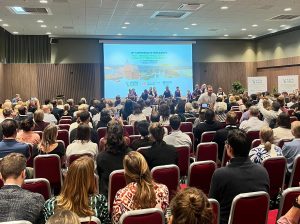
Dr Harriet Wingfield, Research Fellow at the AWRC, shares her reflections on attending the Health Enhancing Physical Activity (HEPA) Europe conference in Kaunas, Lithuania, in this latest piece for AWRC Voices.
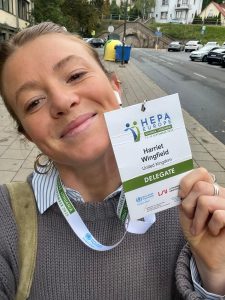 There’s something special about arriving at a new city with a purpose. In my case, arriving in Kaunas, Lithuania, for the Health Enhancing Physical Activity (HEPA) Europe Conference. I felt excited and slightly apprehensive about the opportunities to soak in as much as possible and network with individuals from across Europe and beyond.
First impressions of Kaunas
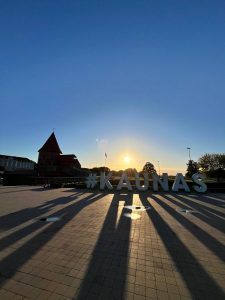
After a quick taxi ride into the city, I learned my first Lithuanian word – “thank you” – which, very charmingly, sounds like a sneeze (“ach-oo!”). Everyone I spoke to was very friendly. Tired from the journey but too excited to stay still, I went for a run along the river that first evening. First impressions of Kaunas were great – everywhere I looked, people were out walking, cycling, or playing sports. The city’s public green spaces and network of cycle lanes were buzzing with activity. My route took me past Kaunas Castle and along the famous Laisvės alėja (Liberty Avenue), one of Europe’s longest pedestrianised streets, stretching for more than a mile beneath a canopy of trees, leading up to a grand white church. It set the tone perfectly for a conference which has some focus on designing conditions and environments that enable physical activity as an everyday choice.
 Making connections
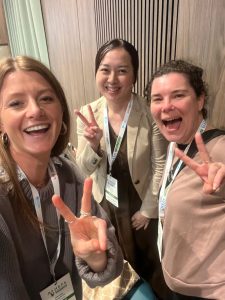
On the first morning, I walked into the venue and was immediately greeted by two familiar faces, Erica Randle (La Trobe University, Melbourne) and Nicole den Braver (Amsterdam UMC, The Netherlands) – whom I’d met last year at the ISBNPA conference in Omaha. It’s moments like this that remind me how collaborative and supportive the physical activity research community can be. I immediately felt more relaxed, and this set the stage for a few days of great conversations and friendly fellow-conferencers.
Learning and Sharing at HEPA
The conference programme was packed with fascinating sessions, covering everything from active travel and policy evaluation to community engagement and some systems approaches. I was particularly drawn to the World Health Organisation (WHO) focal point session on Monitoring and Evaluation. Hearing representatives from multiple countries discuss challenges faced in their respective countries around monitoring and evaluation was both insightful and reassuring – we’re all grappling with similar challenges around building confidence in different approaches, impact and cultures of learning.
During the discussion, I shared insights from our work as the National Evaluation and Learning Partnership (NELP) for Sport England. I introduced our approach to understanding system change through the System Maturity Matrix, a framework developed through learning with local places across England. There was strong interest in how we use this approach to support evaluation and learning within complex systems, rather more traditional measures.
 I also spoke about our use of Configurational Comparative Analysis (CCA) – a method that allows us to explore patterns across large datasets of self-assessments from local partners. This approach, supported by our open-source tool EvalC3, helps identify potential pathways to impact. This generated real curiosity from colleagues across Europe. It was encouraging to see that even from a brief explanation, our approach and methods resonated with individuals from across Europe working in policy, practice and academia.
Of course, some of the most valuable discussions happened outside the formal sessions, over coffee breaks, during poster sessions, and at the evening networking events. These informal exchanges reinforced the importance to me of building networks, sharing challenges and recognising opportunities for collaboration – not only across research disciplines, but also between policymakers, practitioners, and communities.
Reflections and looking ahead
 At the end of the conference, I reflected that within the HEPA space and amongst various European contexts, systems thinking in physical activity is gaining some momentum. And there is a growing recognition that we can’t address inactivity or health inequalities through isolated interventions, however shared challenges relating this to the policy space continue to exist.
Returning from Kaunas, I felt inspired to follow up on the connections I had made. Some of the policy individuals I met will hopefully contribute to my ECR internal fellowship at SHU next year, a project to investigate how Whole Systems Approaches are interpreted and operationalised for physical activity policy across different global contexts.
Linking Back to AWRC’s Mission
This experience strongly reflects what we strive for at the Advanced Wellbeing Research Centre (AWRC), fostering interdisciplinary, values-based collaboration and creating research that promotes lifelong physical activity and reduces health inequalities. Conferences like HEPA Europe show how these ambitions are shared internationally, and how by connecting across sectors and borders, we can aim to contribute useful information with a real-world impact.