
Unpicking the blame game: reducing weight stigma with novel approaches to obesity management
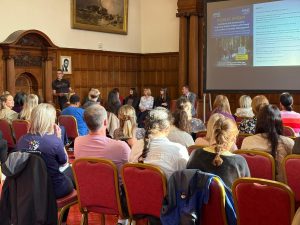
Last week, Sheffield played host to the 2026 UK Congress on Obesity (UKCO), organised by the Association for the Study of Obesity. The three-day event, titled Obesity Through Different Life Stages, brought together experts to share the latest scientific research, policy developments and patient perspectives, addressing key challenges in obesity and weight management.
The Advanced Wellbeing Research Centre was proud to sponsor a satellite public session titled Unpicking the Blame Game: Reducing Weight Stigma with Novel Approaches to Obesity Management. Hosted at Sheffield Town Hall by the city’s Director of Public Health, Greg Fell, alongside Professor Jim McManus, Director of Health and Wellbeing, Public Health Wales, the session focused on a pervasive yet often underacknowledged form of bias in public health: obesity stigma.
Whether through negative language and imagery or discriminatory service design and delivery, research suggests that stigma oversimplifies the complex causes of obesity, drives unhealthy behaviours and is associated with poorer physical and mental health outcomes.
Opening the presentations was Scott Lloyd of Middlesbrough Council and Redcar and Cleveland Borough Council. Scott acknowledged that, although obesity has overtaken tobacco as a leading risk to health in some regions, public health efforts have not achieved the scale or impact seen in policies to reduce tobacco use. This is not due to a lack of policymaking: between 1992 and 2020, 14 government strategies and 689 obesity-related policies were created. Rather, public health finds itself in a David-and-Goliath battle, competing against an industry with far greater resources and influence. While stigma resorts to individual-level blame, evidence points to a much more complex picture and a very uneven playing field. The solution, Scott suggested, lies in collective action around a shared public health agenda.
Claire Woodward then presented Hallam-led research exploring online discussions about childhood obesity. Following national media reporting on children attending Complications from Excess Weight (CEW) clinics, Claire and colleagues analysed online comments and found recurring themes of parental responsibility and individual blame, with little acknowledgement of wider social, environmental and economic influences. The study also highlighted the use of stigmatising imagery and makes recommendations for more accurate and respectful portrayals of children and young people living with obesity.
Maintaining the focus on children and young people, Saima Nazir Desforges of Doncaster Council introduced the Nourish and Nurture Service, a weight-neutral pilot programme designed to support positive relationships with food from infancy. Developed in response to rising levels of childhood obesity in some of the city’s most deprived communities, the service takes a holistic approach to supporting long-term health. More than half of participating families live in the most deprived areas of Doncaster, and ongoing evaluation will help shape the programme’s future development.
Building on the theme of local authority service delivery, Jenny Thompson of North Yorkshire Council reflected on the development of Healthy You, a compassionate, psychologically informed, weight-neutral service. Adapting behaviour change tools such as Evans and Perkins’ WHEEL model, the service uses bespoke tools to support conversations around lifestyle and wellbeing. Jenny explained that a weight-neutral approach enabled the team to demonstrate a wider range of health and wellbeing outcomes beyond weight loss, making the service accessible to groups including pregnant women.
Wrapping up the presentations were Chloe Singleton and Angela Williams of East Riding of Yorkshire Council. Chloe drew on her master’s research exploring how language used around weight and obesity can shape healthcare experiences. Her findings suggested that stigmatising language can reduce engagement with healthcare services, while compassionate and inclusive communication can improve both patient experience and engagement. The research informed the development of More Than Weight, a system-wide, person-centred and stigma-free approach to health and wellbeing in East Riding. Angela outlined the initiative, which places trust, engagement and wellbeing at its centre, rather than focusing solely on weight loss.
The session concluded with a lively Q&A before Professor Jim McManus brought proceedings to a close. While each speaker approached the issue from a different perspective, a common theme was clear throughout the evening: obesity stigma is a significant barrier to health, and tackling it requires compassionate communication, collective action and services that recognise the complex realities of people’s lives.
Many thanks to Dr Cath Homer of the UKCO organising committee and AWRC theme lead for inviting us to participate.