
Working Alongside Students: Guidance for SoTL Projects

Working alongside students is a key aspect of Hallam’s Student Success Strategy and one of Felton’s five SoTL principles that SoTL@SHU align to. Therefore, you may be interested in working alongside students within a commissioned or micro SoTL project. There are a few different ways of working, and each have benefits and challenges to consider at project inception. This blog post outlines the practicalities of working alongside students and provides an illustrative example from a recently completed SoTL project.
Students as participants in SoTL projects
You may be interested in evaluating the impact of a module enhancement on student experience and student opinion is sought from survey completion, focus group engagement or other research method. Participation in data gathering (voluntary, consent to collect/use data is required) is distinct from engaging in a learning activity (designed as part of the curriculum and module pedagogy). Student participants are typically sourced by the project lead, usually as part of their taught cohorts or subject area. Whilst incentives may risk coercion, you may wish to offer a ‘thank you’ for taking part in a voluntary, time bound activity which is distinct from a learning activity or assessment. This is framed differently to ‘payment’ and would likely take the form of vouchers for something of relevance to student lives (e.g. on campus catering). The costs of the vouchers should be proportionate to the time spent on the activity. If students are participating in several activities over a long period of time, an alternative approach may be necessary. Vouchers can be requested by contacting the SoTL administrative support of the funding college.
Students as researchers in SoTL projects
You may be interested in working with students to co-design your SoTL projects or collaborating over a longer period of time with a student researcher/evaluator. This type of work requires students to have a particular skill-set (beyond their experience of being a student) for which they may need to be trained. The Student Engagement, Evaluation and Research Team work with 20 students annually who are appointed through competitive recruitment to a Student Researcher job description. As part of this initiative, students are trained and are paid for the time they engage in training. These student researchers tend to be level 6 or PG students with existing research/evaluation skills. This structured approach enables students to cite paid employment experience on their CV and seek references to support career progression.
SoTL project leads can provide a project brief to the STEER team and request a Student Researcher to work alongside on a SoTL project. A clear brief of the task/s required, outputs expected, timeframe, and maximum hours to be claimed would need to be provided to Joel Kesterton (j.kesterton@shu.ac.uk) who would oversee allocation. Students would complete a timesheet for these hours and be paid via CampusJobs.
Allocated students will have the necessary skills but are unlikely to be from the course/module area of study. If you would like to employ your own student researcher with significant payments, you would need to replicate the job advert and CampusJobs oversight process managed by STEER. This is a time-consuming process. Where possible, and where specific students from a course are required, projects should adopt the above process of payment by alternative means.
The STEER student researchers also work as student consultants and can be asked to review or reflect on things like ideas for new teaching approaches, resources, policies or student guidance documents which may be activities or outputs of SoTL projects. As the students are already paid by STEER for this activity, this cost is covered and would be at no cost to the SoTL Project itself.
In both circumstances, project leads should think carefully about how to work with students as either participants or collaborators.
Case Example: Evaluation of the Future Now: Collaboration In Action module
Future Now: Collaboration In Action is a multi-disciplinary module that was implemented in 2024/25 across seven courses in Sheffield Creative Industries Institute. In this 20-credit Level 5 module, students collaborated with others to address sustainable development challenges and to develop their career readiness skills working with employers, and with the support of staff. This project explored the impact of the module on students, the wider university, and employers.
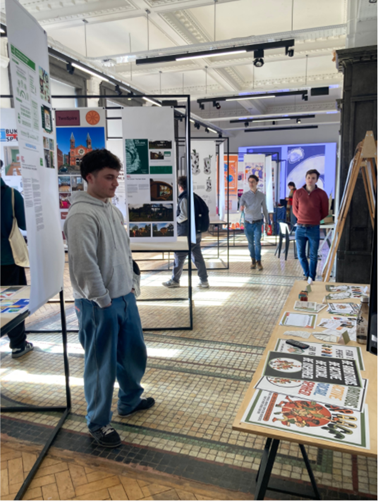
Student Outputs from the Collaboration in Action Module
A Student Researcher recruited by STEER and based outside of the module, was employed to work alongside an evaluator and the module team to contribute to the following tasks: analysing a sample of reflective journals from students; determine recommendations; writing reports and presentations; and disseminating the findings. Training was provided on qualitative research methods and analysis, evaluation, and ethics. The number of hours to be spent on each task and the training was agreed with Hayden in advance. They then submitted a monthly ‘timesheet’ which led to their payment being processed via CampusJobs using the relevant College Cost Code. A key benefit of collaborating with a Student Researcher was that it provided additional capacity from an individual who was distanced from the module. This addressed any risks of power imbalances when evaluations are conducted with staff and students from the same cohort. Hayden also drew upon his own experiences as a student to provide unique insights into the evaluation.
Authors
Liz Austen, Associate Dean, Learning Teaching and Student Success
Alan Donnelly, Lecturer in Student Engagement Evaluation and Research,