
UDL Principles for Inclusive Student Voice Work

Universal Design for Learning (UDL) underpins our work in the Library’s Skills Centre, helping ensure that all students can access and participate in academic skills support. While UDL is often discussed in relation to teaching practice, it also plays a significant role in how we facilitate student voice work with our Library Student Panel.
Our 22-member Library Student Panel is an advisory group that meets in MS Teams to share feedback on Library services and wider student experience. The panel was created to reduce barriers for students with complex lifeloads and to offer an alternative to more time-intensive partnership initiatives in the team. These included commuters, disabled students, and those from marginalised groups: voices that are often the least heard in traditional feedback spaces.
In our 90-minute panels, we use the three core UDL principles as guiding questions when designing our facilitation approach:
- Engagement – How can we motivate panellists and keep them involved?
- Representation – How can we make the content clear and accessible to everyone?
- Action and expression – How can we help panellists to share their ideas in diverse ways?
Below are three practical ways we translate these principles into action:
1. Offer multiple modes of participation
Not all students feel comfortable speaking in group settings, particularly when they are being asked to share opinions or personal experiences about barriers to study. In each panel, students can choose how they contribute by adopting a role during activities:
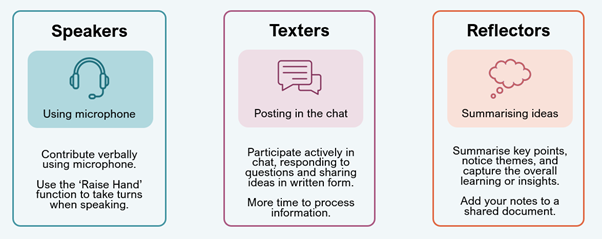
This approach allows everyone to remain in the same online room while contributing in different ways. Students respond to prompt questions through the microphone or in the chat, and we have found the two formats often spark further dialogue. We also introduced a reflector role, where students synthesise the discussion in a shared document. This creates a meaningful option for participants who may need more processing time, experience technical barriers, or prefer to contribute in a different way.
2. Provide asynchronous routes for contribution
Student voice doesn’t need to be limited to live discussions. Each of our panels includes an asynchronous option for students who are unable to attend. After each session, the slide deck is converted into a short workbook and shared with panel members. Students respond to the same prompts and discussion questions within the same 90-minute timeframe as their peers: an approach that accommodates students with busy schedules, ensures equity in access to paid hours for the role, and simplifies our post-panel analysis.
3. Build community around live meetings
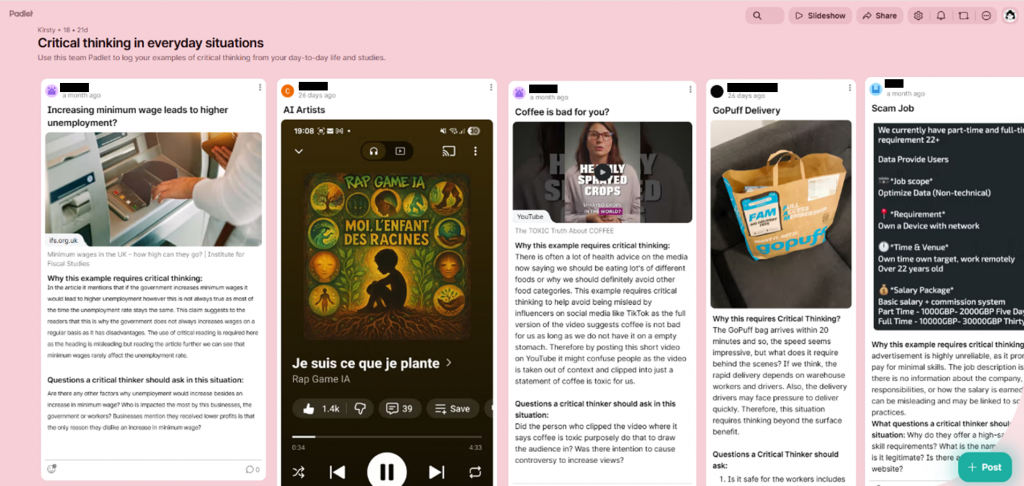
Creating opportunities for students to share ideas before and between sessions can strengthen engagement in live discussions. We use digital tools like Padlet to introduce topics ahead of panels and invite students to share applied examples from their own experiences. These spaces help ground more abstract topics in everyday student life and give participants time to reflect before a live conversation.
Padlet has also helped us to build a sense of community and accountability in an online environment, while ensuring quieter voices have space to contribute ideas that can be explored during the session:
Final thoughts
While our Library Student Panel meets regularly and benefits from consistency over time, these approaches are transferable to other forms of student voice work including one-off workshops, focus groups, and ongoing partnership initiatives.
The three UDL principles provide a useful starting point when designing activities that offer multiple ways for students to contribute. This might involve different communication modes, digital tools to gather ideas before or after meetings, or asynchronous options to fit around student lifeloads. Small design choices like these can make a significant difference in ensuring all student voices, particularly from marginalised groups, are heard.
Authors
Dr Kirsty Hemsworth and Jayne Evans, Skills Managers, Library’s Skills Centre