
Starting with the Why: Five Questions for Gathering Student Voices

Introduction
Effective student voice activity begins with a clear purpose rather than an individual approach. This blog post summarises guidance developed by the Student Engagement Evaluation and Research (STEER) team to support modules, courses and Schools/Institutes in selecting appropriate approaches to gathering student voices. We pose five simple questions to help guide these decisions.
Figure 1: From ‘Why’ to ‘How’: five questions that can guide student voice activities.
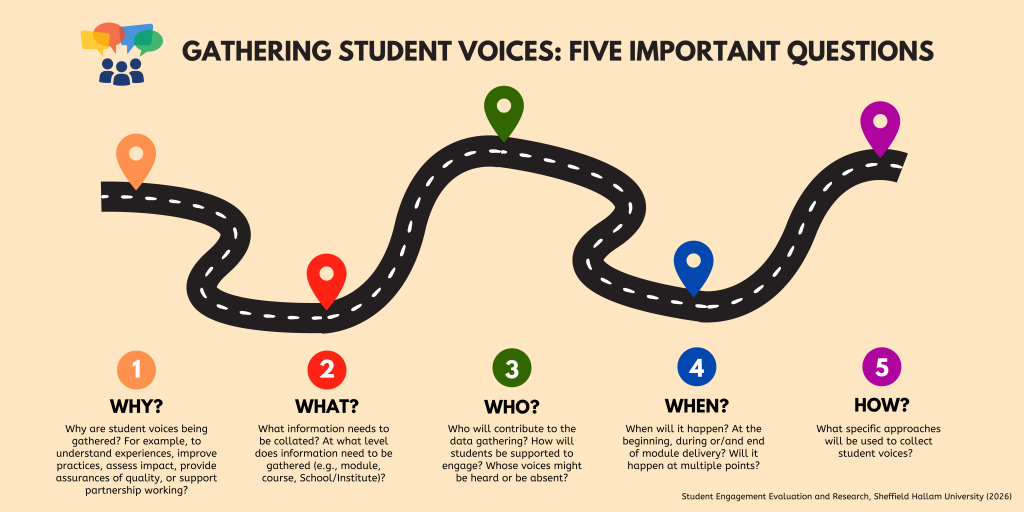
Why gather student voices?
Establishing the purpose of the data gathering first will inform what insights are needed and when and how they can be collected most appropriately. Avoid starting with the ‘how’ (methods-driven), which may result in a weak or unclear rationale for data collection and risk reducing the usefulness of the evidence produced.
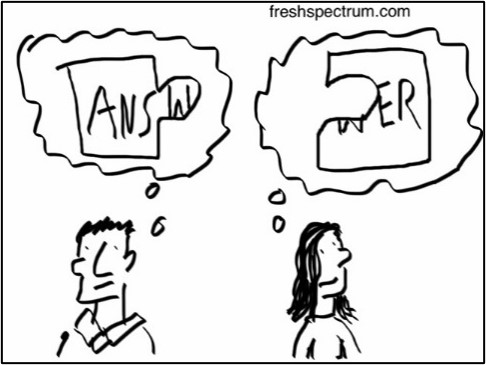
Figure 2: Clarifying the purpose of gathering student voices and the role students will play is an important first step. (image used with permission)
The collation and analysis of students’ perspectives and knowledge can be used for different purposes, such as:
- Understanding experiences.
- Enhancing practices.
- Assessing outcomes and impact.
- Assurance and accountability.
- Partnership.
- Developing skills.
Recording key insights gained from the data gathering and any subsequent actions taken is an important part of the process to demonstrate how students’ voices have informed practice.
What information is needed?
Determine what information is needed and how it will be used, and at what level(s) (e.g., module, course, School/Institute). These information needs may be influenced by staff and students on modules and courses, wider School/Institute or university priorities, and, where relevant, external stakeholders such as employers, industry partners, and Professional, Statutory and Regulatory Bodies.
Who will contribute?
Some student voice approaches provide opportunities for all students within a cohort to contribute (e.g., module and course student experience questionnaires). Other approaches involve a sample of students where it is not feasible or appropriate to involve everyone in a population (e.g., focus groups). They might also be focused on specific groups of students where there is a rationale to explore their perspectives.
Consider how students will be supported to engage in approaches, and whose voices are likely to be heard and whose perspectives might be absent or underrepresented.
When will it happen?
The data gathering could take place at different, and multiple, points of module or course delivery:
- At the beginning to understand students’ prior knowledge and skills, interests, expectations or concerns.
- During delivery to identify opportunities for timely enhancements to learning and students’ experiences.
- At the end to enable students to reflect on their overall module or course experience and to inform improvements for future cohorts.
How will it be carried out?
A questionnaire or a quiz? A collaborative whiteboard or something more creative? There are many examples of student voice approaches that can be integrated into individual teaching sessions/activities, modules, or courses. Examples and templates are provided in the guidance that can be adapted.
Figure 3: Diverse approaches to gathering student voices, illustrating the range of methods that are available.

Guidance for consideration, not prescription
The guidance and examples are intended to support informed decision-making rather than to be prescriptive. There is no single best way to gather student voice insights. Different purposes require different approaches.
The full guidance, which requires a Sheffield Hallam account to access, has been divided into two parts, and it can also be read as a single integrated document (Sheffield Hallam staff login required):
- Considerations for Gathering Student Voices: Why, What, Who and When?
- Considerations for Gathering Student Voices: How?
Once student voice insights have been collated, the next steps are to analyse them, share the learning with key parties, and ensure that any required actions are designed and implemented. The process then begins again, with further engagement helping to illustrate what difference those actions have made.
Author
Alan Donnelly
Senior Lecturer in Research, Evaluation and Student Engagement (STEER)