
Starting Small, Thinking Big: Students as Partners and the 4M Framework

Felten’s (2013) principles of good SoTL highlight that students are not simply the subjects of educational research but should be active partners in the inquiry process. While we often recognise student partnership within individual projects, the 4M framework (building on the work of Friberg, 2016) showcases four layers of potential SoTL impact: micro, meso, macro and mega. It offers an opportunity to consider how students can contribute and experience impact at multiple levels. (See our previous blog post ‘From ‘zooming in’ to ‘zooming out’: Recognising the multiple levels of SoTL impact through the 4M framework‘.)
Using the 4M framework we can demonstrate that students as partners are not simply beneficiaries of SoTL impact. They can be collaborators, advocates, leaders, and scholars who help create impact at every level. By considering both educator and student experiences across the micro, meso, macro, and mega dimensions, we gain a richer understanding of how SoTL contributes not only to enhanced learning, but also to the development of educational communities and future changemakers. Figure 1 provides examples of some of the roles students can have as partners in SoTL and what the benefits might be for the students.
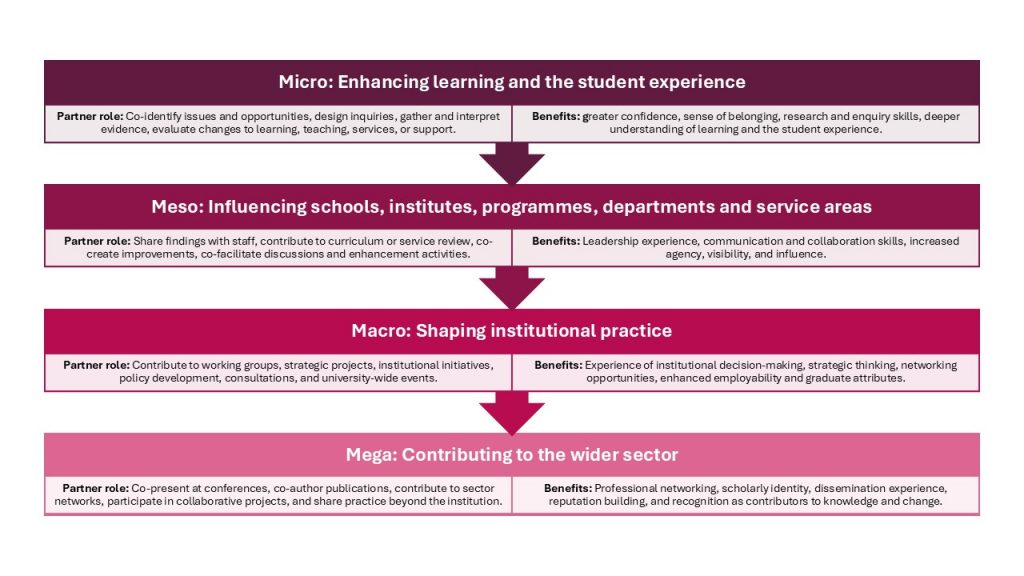
Figure1: Students as SoTL Partners Across the 4M Framework: Roles and Benefits
Micro: Students as Co-inquirers
At the micro level, students help shape investigations into learning, teaching, support, and the wider student experience within a module, service, project, or programme. Students might:
- Help identify questions worth exploring
- Co-design surveys or interview questions
- Analyse findings alongside staff
- Reflect on the implications for learning, teaching and student success
Benefits for students may include:
- Greater sense of belonging and mattering
- Increased confidence
- Research skills development
- A stronger understanding of learning processes
Meso: Students as Contributors to Local Change
At a school, institute, departmental, programme or service area level, student partners can help share findings and influence local practice. They might:
- Present findings to programme and course teams
- Participate in curriculum review discussions
- Co-author a range of outputs from blogs to journal articles
- Co-facilitate workshops or contribute to local communities of practice
Benefits for students may include:
- Leadership experience
- Professional communication skills
- Confidence in working with university staff
- Recognition as changemakers
- Exposure to scholarly and academic communities – essential for academic talent management
Macro: Students as Institutional Partners
At the institutional level, students may help shape broader educational enhancement. They might:
- Join institutional working groups, committees or governance structures
- Inform policy development
- Contribute to institutional learning and teaching conferences and events
- Support institution-wide research projects
Benefits for students may include:
- Understanding of institutional decision-making
- Strategic thinking skills
- Increased agency and voice
- Enhanced employability skills
- Deep understanding of higher education systems and environment – great scaffolding for the next generation of academics and education practitioners
Mega: Students as Co-creators of Sector Knowledge
Looking beyond the institution students may:
- Co-author sector publications
- Present at disciplinary and external conferences
- Participate in national student partnership initiatives
- Contribute to sector-wide conversations about learning, teaching and the student experience
Benefits for students may include:
- Scholarly identity development
- Professional networking opportunities
- Publication and presentation experience
- Recognition as knowledge creators
Summary
A project that begins with a question about one thing may go on to influence colleagues, shape institutional practice, or contribute to disciplinary or educational knowledge. Equally importantly, students who partner in SoTL can experience impact at every level alongside educators. By looking beyond immediate outcomes and recognising these wider ripple effects, we develop a richer understanding of the value of SoTL and the many ways it contributes to enhancement across higher education.
The Mega level is perhaps the most overlooked level of partnership. While students are often involved in local enhancement activities, they are less frequently recognised as contributors to disciplinary and sector-wide knowledge.
Viewing Students as Partners through the 4M framework will hopefully encourage us as educators to not only zoom in, but also to zoom out. At the micro level, students can help improve learning and the student experience. At meso and macro levels, they can contribute to local and institutional enhancement. At the mega level, they can become contributors to wider scholarly and sector conversations. The framework can help us to see that partnership is not confined to the classroom; students can be collaborators, change agents, and knowledge creators across all levels of higher education.
As you reflect on your next or recent SoTL project, consider: What could the impact at the micro, meso, macro, and mega levels be and how are students going to help you to shape that story?
Highlighting this in your SoTL project registration will enhance not only the likelihood of approval and sign-off, it will also ensure the students are rewarded for their input with their development and networking opportunities the SoTL@SHU can help provide.
References
Felten, P. (2013). Principles of good practice in SoTL.Teaching and Learning Inquiry, 1(1), 121–125. https://doi.org/10.2979/teachlearninqu.1.1.121
Friberg, J. (2016, July 11). Might the 4M framework support SoTL advocacy? The SoTL Advocate [Blog]. https://illinoisstateuniversitysotl.wordpress.com/2016/07/11/might-the-4m-framework-support-sotl-advocacy/
Authors
Sue Beckingham, Associate Professor and Joel Gray, Associate Dean Learning, Teaching and Student Success
College of Business, Technology and Engineering