
Embedding Carbon Literacy Training in Undergraduate Built Environment Curricula

Carbon Literacy (CL)
Given the importance of ensuring the future workforce is prepared for the challenge of decarbonising the built environment, Sheffield Hallam students on the undergraduate degree courses for Quantity Surveying, Building Surveying and Construction Project Management learn about environmental methods during each level. They are introduced to sustainability in the residential sector at level four, before progressing to flood-resilience at level five. In their final year, they engage in a Climate Action Retrofit Project using a real local case study and engaging with an employer.
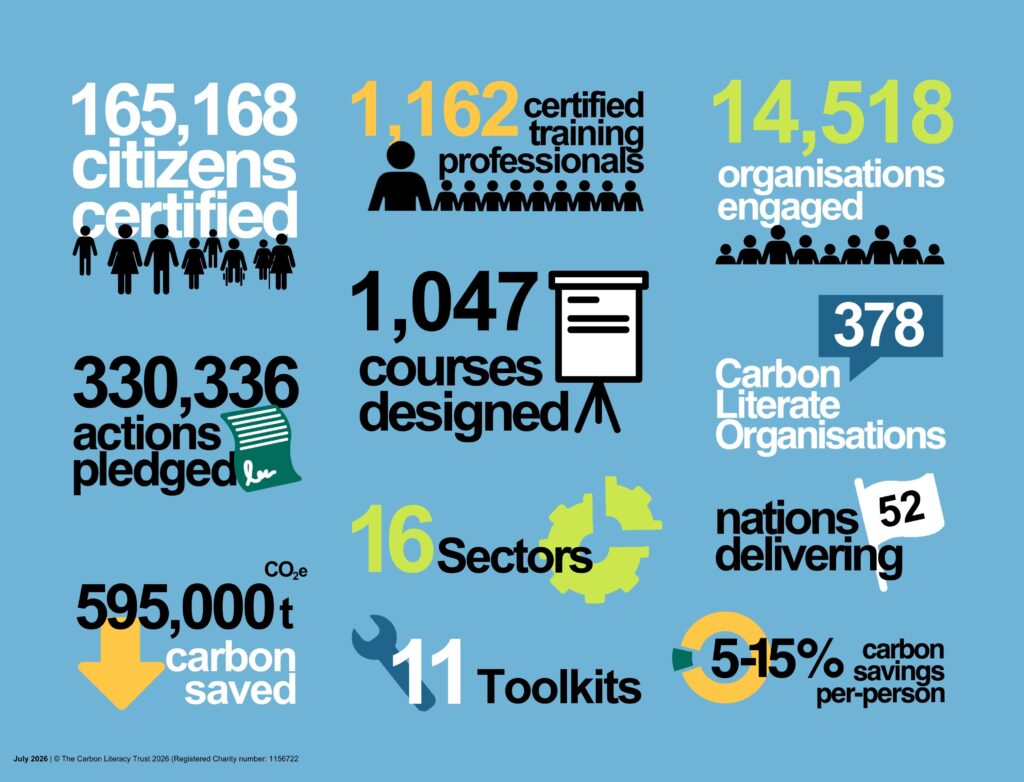
The Carbon Literacy Project (CLP) (2026) describes CL as, “An awareness of the carbon costs and impacts of everyday activities, and the ability and motivation to reduce emissions, on an individual, community and organisational basis”. Embedding Carbon Literacy training at level four provided an opportunity to develop students’ understanding of their personal impact on carbon emissions as they begin learning about decarbonisation in their future professions.
Execution of the training
First, the logistics involved four academic members of staff undertaking the one-day training course themselves. Following certification, staff completed a further 1.5-hour online course titled ‘Delivering Successful Carbon Literacy’. To receive the certificate, it also costs £15 per person to have a commitment document reviewed by the CLP. Budget approval was therefore required. Lastly, the university CL training pack was adapted for delivery through three two-hour seminars, a two-hour lecture, and a support session for commitment document preparation.
Ultimately, the careful planning resulted in a robust execution of the training. However, there were naturally a few challenges with embedding an externally accredited qualification into a module. These highlighted opportunities for improvement in future years.
Overcoming challenges
Challenges in the delivery and success of the initiative included student attendance, timely submissions and aligning CLP requirements with university assessment methods. The qualification requires attendance and completion of two pre-course activities. Many students met this without any issues, however there were several students who missed one or more sessions or were consistently late and missed key elements of the training. Other students attended the training but did not submit their commitment document by the deadline. Consequently, some students were unable to obtain certification. An emergency alternative assessment was provided, however not everyone chose to complete it. Finally, to encourage attendance and engagement, the certificate was embedded into the assessment criteria as 15% of the coursework mark. This led to grade inflation for those who received a flat 15-marks, and those who were not certified experienced the opposite.
The following are recommendations to streamline the approach:
- Delivering the training across two longer timetabled sessions to promote clarity of attendance requirements for students and to simplify monitoring for staff.
- Providing pre-determined mark for different levels of engagement (e.g. 2:2 for 75% attendance, 1st for the certificate) for a more even distribution of marks.
- Determining a well-defined alternative assessment in advance of issues arising, ready to provide to the students when needed.
Initiative Successes
Overall, the training was hugely beneficial. Feedback confirmed that it led to students increasing their understanding of the greenhouse effect, how their own actions contribute to this and how they can influence others to reduce their carbon footprint in their personal and future professional lives. Of the c. 90 students who are on the module, 70 obtained a certificate. This certificate provides them with an additional relevant qualification as they apply to placements and graduate positions, in turn supporting student and university employability objectives.
Author
Elizabeth Olley, School of Engineering and Built Environment