Researcher completes stair marathon to raise funds for the Motor Neurone Disease Association
It was a cold winter’s day back in February when Alex Bugg, a researcher from the School of Sport and Physical Activity, announced that he planned to undertake a ‘stair marathon’ in the summer.
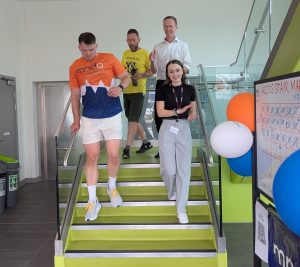
This declaration was met with confusion – “a… what?” “a stair marathon. A marathon up and down the stairs of the Advanced Wellbeing Research Centre.” Was this possible? No one was sure, but we knew we had to find out. Armed with a tape measure, we set about measuring the course. To cover the full 26.2 miles, Alex would need to travel up and down the stairs 227 times, covering 4,600m ascent – more than the ascent from Everest’s base camp to summit.
This wasn’t just about proving that it could be done. Last year, our colleague Andy Tipple was diagnosed with motor neurone disease. Despite the challenges Andy has, and continues to face, he has approached his journey with an admirable strength, grit, and resilience. Acknowledging this, Alex was inspired to undertake an appropriately demanding challenge to raise funds for the Motor Neurone Disease Association (MNDA).
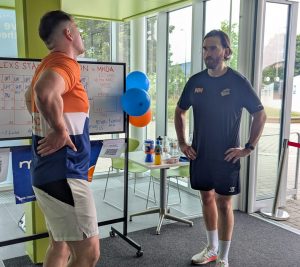
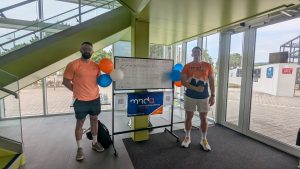
Five months later, at 7:18 on a cool summer’s morning, Alex set off – to an empty building and little fanfare – on the challenge that lay ahead of him. He started strong, lap after lap tallied off by a growing number of volunteers who – along with our reception and multiskilled teams – provided champion levels of support and encouragement.
The AWRC, located on the Sheffield Olympic Legacy Park in Attercliffe, spans six floors and was purposefully designed to promote physical activity. Its bright, pale green staircase incorporates principles of biophilic design, encouraging people to take the stairs rather than opt for the lift. We anticipated this could be an effective way to get people moving. Perhaps, we pondered as Alex hit the five mile mark, we had not appreciated just how effective!
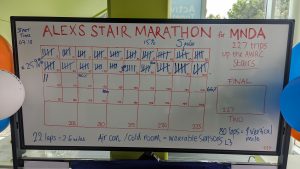
Over the next few hours, a series of enthusiastic friends and colleagues accompanied Alex, powered by an endless supply of bananas, Lucozade, and Haribo. Around 17 miles in, the strain began to show, and the sheer extent of the challenge became stark. Alex was suffering with a persistent knee pain and the descents were becoming increasingly challenging.
Luckily, the AWRC’s colocation model – which brings together Hallam researchers from multiple disciplines to work alongside professional services staff, research students, NHS clinicians, industry partners, and community groups – sprung into action. From the NHS physiotherapist who provided an impromptu sports massage, to the sports engineers who devised an on-the-spot innovation that allowed Alex to use walking poles indoors, everyone chipped in to ensure the challenge continued.
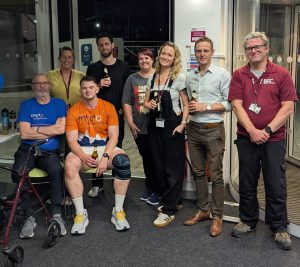
At 23:18, exactly 16 hours after Alex first bounded up the stairs, he made his final descent – a little less bouncy but no less determined. He tallied off the final lap to the somewhat fitting ‘Fall to Pieces’ by Velvet Revolver, and to rapturous applause from wife Beth and the crowd who had stayed to provide support.
Andy Tipple, who had led the support efforts through the day, was on the finish line to congratulate Alex (and hand him a very well deserved cold beer.)
Reflecting on the event, Andy said: “I want to say a huge thank you and many congratulations to Alex on his incredible achievement and for raising money to help find a cure for Motor Neurone Disease.
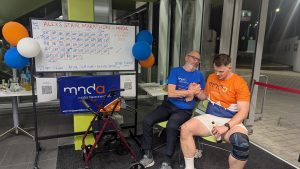
“Your unbelievable fundraising efforts and dedication will certainly have a very positive impact on those living with the disease and your commitment is truly inspiring! I am very proud of you Alex, not only has your challenge helped me, but more importantly will help so many others and their families living with MND in the future.
“I would also like to say thank you so much to everyone who had donated. Your kindness and generosity have been staggering.”
At the time of writing, Alex has raised £1,690, which represents 169% of his target. You can donate at: https://www.justgiving.com/page/alex-bugg-1