
Using place based systemic approaches to build active communities
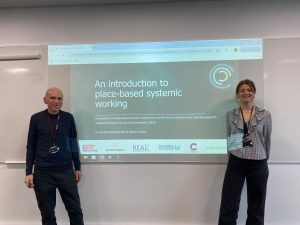
Dr Harriet Wingfield and Dr Simon Amour of National Evaluation and Learning Partnership (NELP) team led this week’s AWRC Lunch and Learn session, providing insights into their work and the place-based systemic approaches (PBSA) in which it is grounded.
The NELP consortium, led by Sheffield Hallam University and funded by Sport England, evaluates how physical activity (and inactivity) is shaped by the whole systems in which people live and work.
We know that physical activity is good for us, yet many of us find it difficult to reach recommended levels. PBSA works on the assumption that rather being due to individual failures such as laziness, lack of motivation or interest, the environments and social systems in which we live have a much more significant impact on our habits. Factors such as working conditions, safety, transport, green spaces, local infrastructure and community assets all interact to shape how active we are.
The NELP team support places to undertake realist-informed evaluation of these place-based systematic approaches (PBSA) to better understand what works where, for whom and under what circumstances. They aim to better understand the conditions that reduce physical activity inequalities in specific contexts. PBSA accepts that life is messy and complex, so evaluation can’t rely on isolating variables or identifying linear cause and effect.
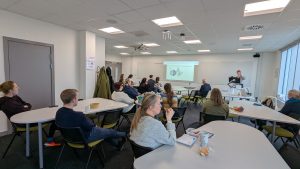
Instead, it is interested in demystifying patterns and relationships and creating long term system shifts that create the conditions that make it possible for communities to be active. This may be through investing directly in skills and capacities, strengthening community institutions, embedding physical activity into cross-sector policies, and – importantly – developing approaches that are not reliant on short-term funding cycles.
Harriet and Simon brought the session to life with case studies, including Hackney, where local authorities actively involve residents in shaping activities, and Bradford, which has focused on creating the conditions for young people to develop active habits.
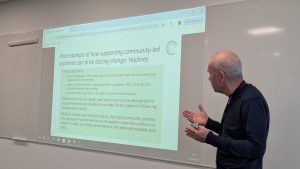
There was lively discussion following the session, including about challenges securing funding without casual statistical data or control trials (the team undertake Configurational Comparative Analysis, a research and evaluation method that integrates both qualitative and quantitative data to compare patterns across case-studies and identify which conditions, or combinations of conditions, lead to a desired outcome, and to explore why this might be).
Discussions also explored how to define ‘place’ (an ongoing challenge, but what’s important is that the definition is community-led), and what success would look like (trained ambassadors, self-sufficient regional clusters, and more people moving more!)
Thank you to Harriet and Simon for another fascinating session. If you are interested in their work, you can read much more on their website: www.evaluatingcomplexity.org and on the NELP project page: https://www.shu.ac.uk/advanced-wellbeing-research-centre/projects/nelp