
Creating a tailored exercise pathway for people living with stroke
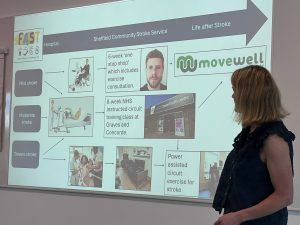
This week’s Lunch and Learn was delivered by Principal Research Fellow Dr Rachel Young of the School of Health and Social Care, who shared examples of how AWRC research and innovation are helping to improve access to physical activity for people living with stroke in Sheffield.
Rachel highlighted how national guidelines have recently raised the bar for stroke rehabilitation, recommending up to three hours of activity per day to support long-term recovery. Yet people with moderate or severe stroke typically take fewer than 4,000 steps per day. Without continued activity, both physical and cognitive decline is likely.
Working closely with Sheffield Teaching Hospitals, the AWRC is co-developing solutions that respond to the complexity of stroke recovery, particularly for those with lasting fatigue or reduced mobility. One example is a pathway pioneered by researcher Nik Kudiersky, which introduces patients to seated and upright cycling as part of their rehabilitation. Funded in part by the Trust’s ‘Dragons’ Den’ initiative, this approach has already led to a 40% increase in therapy activity.
There’s no one-size-fits-all route. Patients recovering from a mild stroke may be discharged from NHS rehabilitation services within 28 days, but still face significant challenges, while those with more severe impairment are often confined to a couple of rooms at home. For this group, supported movement through equipment like recumbent bikes or guided therapy is essential but difficult to access.
Last year, a new pilot brought clinical, psychological, and dietitian support together under one roof at the AWRC. Exercise is now being integrated more systematically, with signposting to Movewell or stroke-specific circuit classes, including those delivered by STH clinicians.
Looking ahead, Rachel and the team are leading a new NIHR-funded study called PACE4S (Power Assisted Circuit Exercise for Stroke). Using adaptive equipment provided by Innerva, the study will co-design interventions with people affected by stroke, including those living within Sheffield’s Somali community, to ensure an inclusive, sustainable approach. Four Innerva machines will be installed in the Motion Analysis Lab by spring 2026, supporting workstreams from protocol refinement to programme development with leisure providers and commissioners.
The team is also developing a Smart Balance Active Device for potential use at home or in the gym, with researchers from the Sports Engineering Research Group contributing to the circuit-based rehabilitation model.
Find out more about the AWRC’s Technology Assisted Rehabilitation research theme